Loose parts: Introducing open-ended play
Smoothing sand to make roads for toy cars. Collecting stones and building hills for toy animals to climb. Sticks and leaves becoming fish and chips at a takeaway shop. Hair brushes becoming microphones for pretend rock stars. Adding mother’s shoes, a scarf and an old shirt to complete an outfit for a runway show. Fun childhood memories are created with random items that are gold for children in their play. Thinking back to childhood, there are many memories of using loose parts which weren’t called that back in those days. Now they have a name. Now they are valued. Loose parts are no longer only found by children but are now being more accepted and added by adults to enhance the play environment.
While there is a place for devices and bought toys, as teachers we have observed the magical effect on children that loose parts seems to provide. We advocate for loose parts for that reason. They can be as captivating a device or shiny new toy but observe a child with either of those and then observe a child engaged in loose parts play and there is a remarkable difference.

Loose parts can be separate collections that are used as is or added to other loose parts collections. This should be the child’s choice. Loose parts can be from nature or recyclable objects or household items or random items. Whatever they are, we urge you to take the time to watch your child or children engaging with them. At first you may get the stunned look from children who don’t know what to do with the random objects that you have supplied. It may be necessary for you to help first time loose parts users. Step in with some wonder questions. Examples are “I wonder what I could use this for” or “I wonder if this can be a …” or “I wonder what I can make if I put this with that.” You can also go ahead with your own creative thinking and start playing by taking an item or items and diving into pretend play. Once children see you doing this, it will likely inspire them to do the same.
Loose parts can be used by every child with no adult expectations other than to be sensible when playing. Observe the motor skills, oral language, creative thinking, negotiating (if playing with others), innovative thinking, problem solving, risk taking to name a few possibilities of what you may see. The play, in our opinion, is very different. Imagination is the only limit with loose parts play.
We think the most exciting part of loose parts is the unexpected genius of the child. So often we adults look at the play set up, we have our own ideas of how this could pan out. So often the child or children think of something that is far more exciting than what we imagined! Not only that, if you look closely you may see glimpses of who your child may be later on and who they are as learners. Different children are drawn to different loose parts and that’s exciting! Different children will use the same loose parts for different purposes. That’s exciting too. You may see your child work alone or naturally gravitate and work with other children. You may see your child take huge risks by trying something challenging or you may see your child have a definite plan in mind and persevere until the job is done. So much to see so take the time to observe your child or children and marvel at their own unique genius thinking.

We can’t stress enough the benefits of providing loose parts for children to play with. One more piece of advice is to not underestimate children’s abilities. Don’t set the ceiling but rather provide more variety of loose parts that will challenge thinking. Take time to observe what unfolds. We are pretty confident that you will see some wow moments that won’t be visible with traditional learning, using devices and playing with toys. May the magic of loose parts play bring you and your children joyful learning!
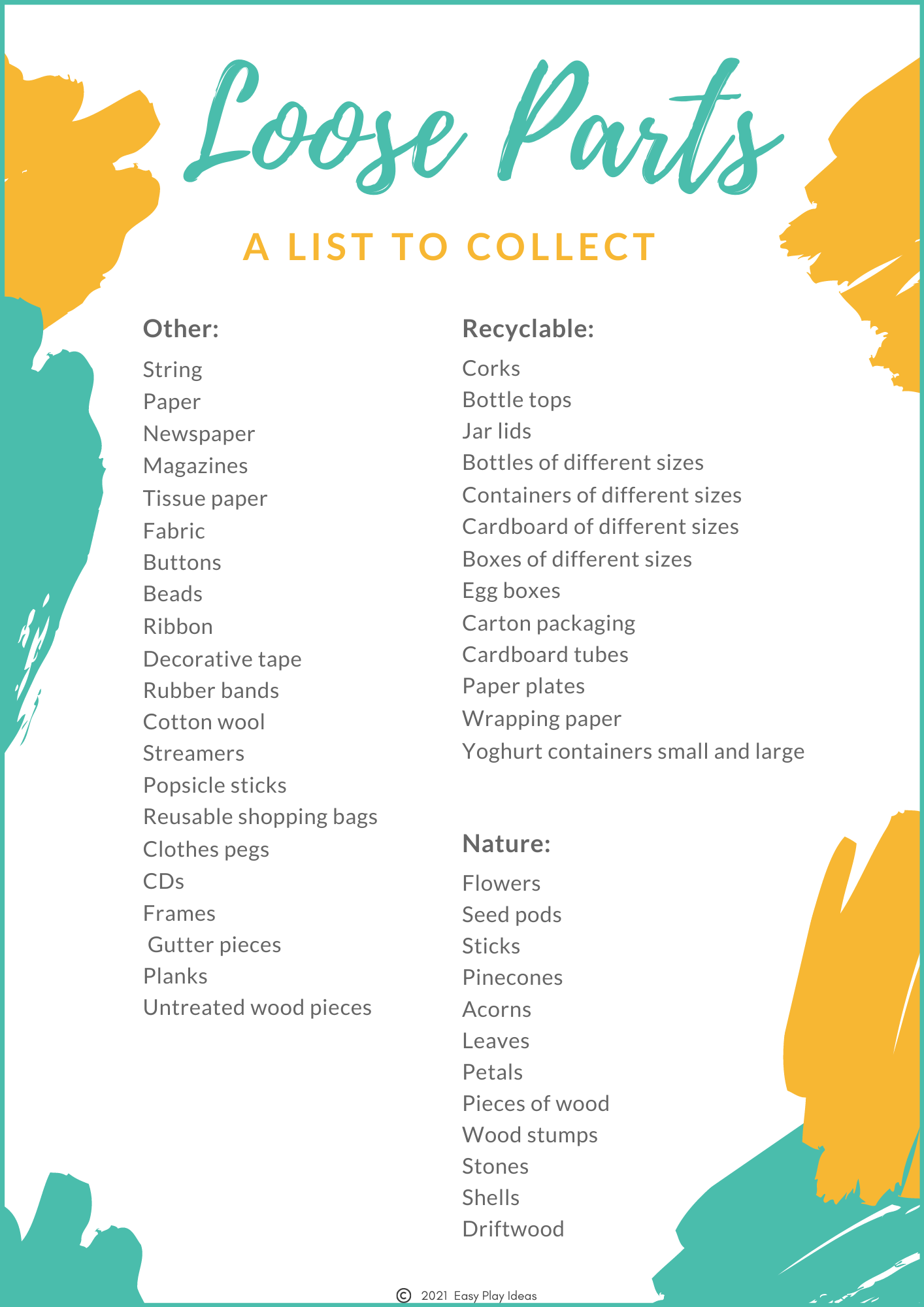
For a list of loose parts to collect for open-ended play, download a list by clicking the button below.
Loose parts resources you may be interested in
Click the images below to find out more.

This bright and fun printable resource offers ten ideas on how to use common loose parts. Challenge cards display a large photo, a title and a short and simple description of each idea, prompting children to try it out.
This resource comes with 100 pages packed with colourful fun for kids to create and enjoy rich learning experiences. To extend further learning there are additional resources including word mats, related display word cards, display pictures and more.
Loose parts challenges are great idea starters and are intended to inspire creative thinking and more ideas.
How to use the challenges?
Use the challenges:
As a prompt for older children who don’t know where to start with loose parts
As an invitation to play with loose parts by having the card displayed (younger children can refer to the photo)
As a classroom challenge using loose parts
As a home or teacher resource for loose parts play ideas
At gatherings or play dates
As rainy day ideas
What loose parts do I need for these challenges?
There are some challenges that you will need specific things for and others you can use whatever loose parts are available to you. All our challenges use simple items that can easily found at dollar stores or craft stores. Items we used are listed on the information page of this resource.
Please note this is a printable PDF and you will be given a link to download the document on purchase.

Colouring in is not every child's favourite activity. We have created a colouring alternative that will develop fine motor skills without the need to hold a pencil. Children can colour in a picture by placing loose parts onto the sheet to fill it in with colour.
Once complete, a photo can be taken of the picture, the loose parts returned and a new picture created. Giant tweezers can also be used for object placement.
There are over 60 pages of pictures to choose from and at least one picture for every letter of the alphabet! These loose parts mats can also be used as playdough mats (if laminated) or a colour by number colouring challenge. Our information page has ideas and photos to show examples of how to use these pages.
Children will love choosing the page and the loose parts to colour their picture in with and it is one of those activities that they will return to for many days to come.
This resource is a downloadable PDF that you can print yourself at home or at a printing shop.